Wednesday, May 14, 2008

UW Jackson School of International Studies Visits 8th Grade Global Studies

The 8th grade has been studying governance and global economics. Yes, they know all about the WTO, IMF, WB, UN Millennium Development Goals, outsourcing, micro-lending, fair trade, and arguments for and against globalized economics!

To add a sense of the great academic, service, travel, and employment opportunities awaiting them outside the walls of the Global Studies classroom,
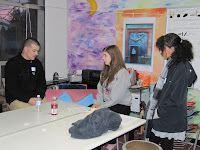
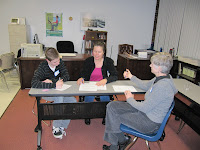
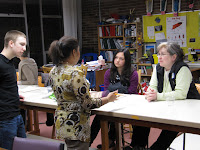
on Thursday, May 8, the 8th grade class enjoyed a blast of higher education from four students from the University of Washington's Jackson School of International Studies.

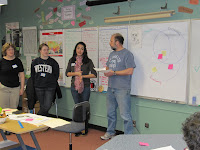
This energetic and well-informed quartet of political science students broke the students into three groups to study apparel, mining, and coffee industries in Guatemala. Our visitors had all traveled to Guatemala to study last summer.
Studying statistics, first hand accounts, and photographs, our students learned about the hazards and limitations of marginal employment, and the struggles of labor organizers in Guatemala. They also explored solutions to be pursued here in the U.S. Finally, each of the three groups presented a poster outlining issues and solutions for the class.

The class ended with 8th graders asking questions to learn more about the wide world of study and career opportunities awaiting them in global affairs and the growing green economy.

Connor designed a lovely thank you card for the class to sign, and Ben heard back from one Jackson School student that she was so inspired by their level of engagement, enthusiasm and intelligence that was now redirecting herself towards teaching. Well done, 8th grade!


Tuesday, March 4, 2008

Bella Roma!

It's amazing what you can see during a week in Rome! The annual 8th grade trip lucked out this year with fantastic weather, so we were out and about all day every day. Maripat did an excellent job of preparing the students for the trip in their Latin classes! Each student researched a different landmark and gave a presentation to the class. Petyr, Virgil, Kristin and Mr. Hundley also contributed their expertise to the success of the trip.

After a long flight, the excitement was palpable as we drove into Rome, and students recognized places like the Colliseum and Palatine Hill. We unpacked at the hotel and then set out to get our bearings and visit the Pantheon. After an early dinner (most Romans sit down for an evening meal around 8pm) and gelato, we meandered back to the hotel to hunker down and try to get some sleep.

Bright and early (VERY early for those with a bit of jet lag) Monday morning we set out for the Piazza Navona to meet our Ancient Rome tour guide. The colorful piazza, a former site for ancient Roman games, came alive as we waited surrounded by Bernini sculptures, local artists, and the stunning Church of St. Agnes in Agone. The tour was a mixture of very old (the Forum), old (the Trevi Fountain), and modern (HUGE jars of Nutella). We also visited the Palatine Hill, where the Roman elite made their homes and played soccer and frisbee in the Circus Maximus.
Day 2 included many more sites including a trip to the Colliseum, St. Peter in Chains, more soccer and frisbee above the Domus Aurea, gelato and delicious food.

On Day 3 we divided into our smaller groups and explored the city while slowly making our way toward the Vatican. Each group chose different things, some of which included visiting Hadrian's Mausoleum, exploring churches, and shopping at open markets. The afternoon tour of the Vatican Museum was highlighted by seeing the Sistine Chapel followed by a visit to St. Peter's Basilica. Jerick climbed the steps to the very top of the Cupola to take in the view of Rome and the Tiber.
Thursday we took a bus tour to the ancient seaport ruins of Ostia Antica where we got to see how the "real" ancient people lived. We saw the remains of ancient baths, a fire station, burial sites and a well built directly in the middle of the ancient road. Back in the city, we walked to the Capitoline Hill Museum. We also tested our honesty at the Boca Della Verita: legend has it that the mouth of this ancient manhole cover will close on the hand of a liar. Everyone in our group returned with two hands.

For our final day, we walked to the Spanish Steps, spent time on the grounds of the Villa Borghese and visited the Borghese Museum.

After somefinal gift buying and an early supper, we made one last trip to the Trevi Fountain: one coin to return to Rome, two coins to find love in Rome and three coins to live in Rome.


Wednesday, January 16, 2008

7th Grade Makes Fast Tracks (in the snow)
When it snows one inch in Seattle that can mean a foot up at Snoqualmie Pass. With record snowfall already this year, the 6th graders hiked into the fluffy stuff with their homemade snowshoes, the 8th graders shredded Snoqualmie Summit with alpine skis and snowboards, and the 7th grade brought their natural talents to Nordic skiing. Those would be attitude, fearlessness, style, and smiles.

For their first outing of the 2007 Explorer West outdoor education season, the 7th grade had both snow and sun aplenty. Nordic names were assigned on the bus, then 7th grade spirit took over. They matched the blessings of nature with gusto and attitude that only 7th graders can muster. Here's Dagrun wondering, "So what's so hard about slithering about on ice atop flimsy little sticks?"

They tolerated faculty attempts at instruction well, and then cooked it their own way. One essential ingredient is always fearlessness, and willingness to fall, as demonstrated by Asta.


The next ingredient is style. You can't lose with Leopard mittens, as Magnus shows us.


It is always wise to accessorize with a viking hat, like Lars. Nobody messes with vikings. Would you mess with this guy?

Friendship and camaraderie are perhaps the most important ingredients. That's what will carry us through whatever the next three weeks of Nordic adventure bring. Asta, Axel, and Brigitta bring smiles.

Friday, November 30, 2007

Native Plants Garden Takes Root!


Explorer West's Award Winning Sustainability Initiative lives on with a NEW NATIVE PLANTS GARDEN!

Last year, in October of 2006, our students planted 25 trees on campus, including an inauspicious circle of eight maple trees just south of the upper parking lot and west of the gym (see photo to left). Thanks to students' (and parents'!) tender loving care (planting, mulching, weeding, and watering), all 25 trees survived their first summer.

In the fall of this year the entire student body and faculty voted on student designs for a native plants garden. Dakota's design won for its star shaped layout and ambitious plant choices.

Supervised by Westside School parent and professional landscaper Matt Stanowich, with help from our
David (drama) and Eric (PE), the garden plot was rototilled and composted in preparation for planting. Hardscrabble was transformed into welcoming and rich soil beds.

Every EW student participated in the planting, watering and mulching of native plant starters secured from local nurseries and the Seattle Arboretum -- whose knowing Master Gardeners have been generous with advice and donated plants. Our planting spree was just in time to beat the first frost. This fall planting gives the tender young plants winter months to settle and take root in anticipation of spring warmth and new growth.

Keep an eye out for soon-to-come permeable pathways and benches!


Tuesday, November 27, 2007

It's Snowshoe Time!


The Sixth Graders are once again designing and building their own snowshoes for use at Snoqualmie Pass in January. Under the tutelage of Cascade Designs Winter Products Manager, Lee Getzewich, students brainstormed various snowshoe features and narrowd down their design by testing different qualities. This year's design will focus on choosing materials for how well they hold up under pressure, tension, and shear as well as in cold and wet conditions.

8th Graders Test Buildings for Earthquake Resistance


The 8th grade science students culminated their study of Earthquakes today by testing their "buildings" on a shake table. Using what they had learned about building shape, mass distribution, and friction, teams competed to design a the tallest structure that would sustain a powerful earthquake. After each test, the class rated the amount of damage using the Modified Mercalli Intensity Scale. The winning building was over 6 feet tall! This activity connected this year's sustainability theme of "Structure" with the earth science curriculum.

Sunday, September 30, 2007

Pinwheels for Peace at Explorer West


On September 21, 2007 -- United Nations International Day of Peace -- Explorer West Students made pinwheels-for-peace, and installed them on the fence adjacent to our school parking lot.

We joined over 1,000,000 students from around the world who make and displayed pinwheels. Pinwheels for Peace is an art installation project started in 2005 by two Art teachers, Ann Ayers and Ellen McMillan from Coconut Creek, Florida. It was created as a way for students to express their feelings about what’s going on in the world and in their lives.

Explorer West students created pinwheels and wrote their thoughts about war and peace, tolerance, and living in harmony with others on one side. On the other side, students drew to visually express their feelings. They assembled these pinwheels, and on International Day of Peace, Sept. 21, 2007, they planted their pinwheels outside as a public statement, and as an art installation.

The spinning of the pinwheels in the wind will spread thoughts and feelings about peace throughout the country and the world!

Thursday, September 27, 2007

Mr. "H" Urges Students Towards the Zone

It's official! In The Zone is in the house!


Today Mr. "H" introduced the entire student body to a tool that students, teachers, and parents can use to maximize their growth, productivity, and performance. "In the Zone" is a method Mr. "H" has employed extensively in his many years of teaching and coaching tennis.

All Mr. "H" asks is that every student commit to becoming more aware of where they are in the scheme of the "Zone" as they face challenges, and try to cope appropriately.


If you are "Tanking" you have simply given up before you even tried. Your fears and low confidence kept you from stepping up to the challenge, whatever it was. At this point it might be good to get some perspective on the source of your fear. Seek advice, support, and clarification. You deserve it. Then try a fresh start.

If you are in "Anger" you have been overwhelmed by frustration. There is no point in beating your head against the wall. Take a break. Do something you will like better, or feel more confident with. Then, when your anger has subsided, try the challenge again.

If you are "Choking" you have momentarily dropped the ball due to pressure. But pressure is a good thing that can call up our best effort, as well as creativity and new angles. You came to play, and did so, even if you were not entirely successful. Ultimately, you will need to show renewed commitment. When you choke, just admit it and move on. We all make mistakes. Our best moment may follow.

The "Zone" is where we all want to be, and where we hope most of our students will be frequently by the end of the school year. When you are in the zone you are prepared and confident, even hungry for challenge. This is when you at the top of your game. When in the zone in class you produce exemplary work -- and then seek extra credit. Or, you might help a classmate, taking your zone to a whole different level.


Experiment with this at home, work and school. Pay each other respect for trying to be "In The Zone."

6th Grade Geography and Ancient Civilizations Classes Explore Cave Art


According to the geological record, the earliest fossilized record of bacteria, a sign of life from the Precambrian era, is 3.5 billion years old. Spiders started showing up much later, just 400 million years ago. Lucy, the oldest upright, bipedal who seemed more human than ape, lived just 50 million years ago.

But hey, we’ve got the woolly mammoth beat! They were late to the show, arriving a mere two million years ago – barely yesterday in geological time.

Using Larry Gonick’s Cartoon History of the Universe and a variety of supplemental sources on archaeological method, cave art, early religion, and the roots of language, the 6th grade has been exploring how humans came to be so complex in so little time – geologically speaking.


You can admire original 6th grade cave art (pastels on crumpled paper!) in the hallway. This display features hands – one of the most common motifs in Cro-Magnon’s Ice Age artistry. These hands – traced, stenciled, and drawn throughout caves 10 to 20 thousand years ago – appeared across the globe, from the Americas to Europe, Africa, and the South Pacific. What did these ancestors of ours intend? Worship? Ritual? Signature? The hunt? Control? Graffiti?

Cave art seems to be a combination of narrative (story), ritual, and symbolic language. These markings tried to say something in an organized fashion, perhaps to give a challenging Ice Age existence meaning and hope.

What language will our students leave for the future? Part of our mission at Explorer West is to give students the tools to envision and work towards a lasting future. The past is a rich place to start.

Wednesday, September 26, 2007

7th graders experience true Northwest weather at Snow Lake


The 7th graders learned a ton about packing and being prepared for the weather on their trip to Snow Lake. They also found out that teamwork, cooperation and a positive attitude are good things to bring along on a backpacking trip.


We left the Alpental parking lot, elevation 3100 feet, at 11:40 am in overcast but dry weather. It took almost 2 hours to get a mile and a half gaining only about 7 or 8 hundred feet in altitude. There we stopped for lunch and put on our rain gear as the wet stuff started to come down from above. Motivated by the rain to cover some ground, the hikers made the next steep section (900 feet of altitude in about half a mile) in around and hour. From there it was all down hill.


We reached Snow Lake around 3:30. All were a little damp and very tired. We found a fairly dry camp site that would fit us and the kids had their tents up in no time, avoiding a pretty good shower that drenched anything not already wet from the day.The campers cooperated to make dinner and stay warm and dry. By morning the rain had let up, though it was foggy and damp.


We made a day hike to Gem Lake at 4900 feet where the students ate lunch, did some writing in their journals and an art project. They also learned a good lesson about leaving no trace on the clean up from lunch. The 2.5 mile hike back to camp took and hour and 40 minutes.


The highlight of the day was a silent hike down to the lake shore once back in camp. The kids sat quietly at the edge of Snow Lake for close to an hour. Later in the day we reflected on that time and students saw the value of experiencing "awesome nature" up close and in person.


The second night we were mostly dry at lights out - and despite a downpour in the middle of the night and some pretty fridgid temperatures, we awoke to blue sky. We broke camp after breakfast and discussed what we had learned about hiking together and taking less breaks. The hiking time on the way out was two hours and ten minutes, quite an improvement from the first day.